Namesake of the Lowe-McFarlane American Legion Post 14

In the years immediately following World War I, the United States government undertook the solemn task of returning the bodies of American soldiers from their graves in France for burial at home.
Shreveport’s Post No. 14 of the American Legion took part in many of these services, as well as the funerals of servicemen who died during that period.
Determined to properly honor their fallen comrades, Post Commander Herman C. Strauss appointed a committee in 1921 to select a namesake for the Post from among Shreveport’s fallen heroes.
The committee chose to honor the memory of Sergeant Robert Francis Lowe and Private Sidney Edwin McFarlane.
Sergeant Robert Francis “Doug” Lowe

Born in Campti, Louisiana, on March 8, 1892, Sergeant Robert Francis “Doug” Lowe was the son of Mr. and Mrs. W. H. Lowe and one of twelve children in a close-knit family.
From an early age, he learned the value of sacrifice and responsibility, qualities he carried with him throughout his life and service to his country.
As a young man, Lowe moved to Shreveport, where he found employment in the city’s rapidly growing community. When the United States entered World War I, he answered the call to serve.
Though the Navy was his first choice, strict enlistment requirements prevented his acceptance. Undeterred, he turned to the Army, enlisting with determination and resolve.
Lowe was sent first to Camp Martin in New Orleans, then to Chattanooga, Tennessee, and ultimately overseas to France. Serving with Company A, 11th Infantry Regiment, 5th Division, he rose through the ranks from Private to Corporal and eventually to Sergeant.
His service took him into some of the fiercest fighting of the war.

During the St. Mihiel offensive, Sergeant Lowe was struck by shrapnel and mortally wounded on September 13, 1918.
He succumbed to his wounds two days later at Evacuation Hospital No. 1 in France.
He was just twenty-six years old when he made the supreme sacrifice for his country.

Following the Armistice, and at his mother’s request, Sergeant Lowe’s remains were returned home.
On August 2, 1921, his flag-draped casket arrived in Shreveport and was carried to Campti, the town of his birth. Funeral services were conducted the following day by Father F. J. Plutz of Natchitoches.
The American Legion of Shreveport was officially represented, and comrades from Campti, Shreveport, Natchitoches, and Chattanooga stood at attention as a final salute was fired.
As the bugler sounded taps and the last notes faded into the distance, Legionnaires paid a soldier’s tribute to a fallen comrade—honoring the life, service, and sacrifice of Sergeant Robert Francis “Doug” Lowe.
Private Sidney Edwin McFarlane

Upon the altar of freedom, Private McFarlane gave his life just seven days before the Armistice.
He was born in Monroe, Louisiana, on September 7, 1895, the son of Mr. and Mrs. D. J. McFarlane. Three years later, the family moved to Shreveport, where the father engaged in the contracting business.
Sidney, the oldest of six children, was educated at Shreveport High School on Hope Street. He loved all kinds of sports, especially boxing and developed a strong physique and took part in many contests at the Athletic Club, of which he was a member.
Love for adventure overcame love for books, and this restless youth quit school a few months before graduation to work on the K.C.S. trains as a news agent.
This did not last long, and “Jeeker,” as he was called, decided to become a painter. It was this trade he was following when Germany began its campaign of unrestricted submarine warfare.
The United States declared war, and Sidney Edwin McFarlane joined Company L, 156th Infantry of the Louisiana National Guard and was sent to New Orleans under Captain Daniel W. Spurlock.
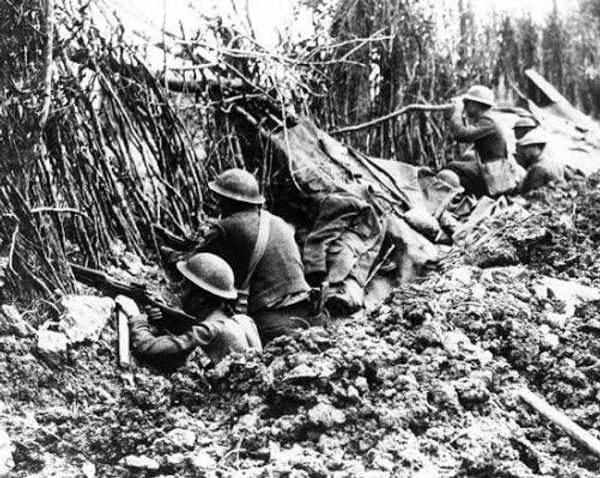
After sailing for France and the Western Front, Private McFarlane was attached to Company B, 9th Infantry of the 2nd Division. This unit took part in the Meuse-Argonne offensive, and Private McFarlane was under fire for days.

On November 4, 1918, when there was a call for three men of Company B to go on a scouting expedition, Private McFarlane stepped forward and, with two buddies, crept out of the trenches toward the enemy lines.
While on this expedition, an enemy shell burst killed Private McFarlane instantly, just seven days before the Armistice. His two buddies found shelter and survived.
This American hero was buried on French soil but was removed to the United States, and, on August 15, 1921, and found his last resting place in Arlington National Cemetery.